


Diablo Immortal
Blizzard Entertainment, Inc.
When I first started Diablo Immortal, I expected a familiar dark-fantasy action RPG squeezed onto a phone. What surprised me was how quickly it established a playable mood: ruined places, threatening enemies, heavy combat, and a constant sense that the world is already in trouble before my character arrives. It is a free role-playing game from Blizzard Entertainment, Inc., designed for people who want the Diablo style in a portable format rather than a short, disposable mobile adventure.
The basic appeal is easy to understand. I move through dangerous areas, fight groups of monsters, collect better equipment, develop my character, and keep pushing into the next challenge. The structure is recognizable, but the mobile format changes how I approach it. I can play for a short session while waiting somewhere, then return later for a longer run when I have more time. That flexibility is one of its strongest qualities, although the amount of progression, menus, and ongoing activity can feel demanding if I only want a simple game to relax with.
The audience response is unusually strong for a mobile RPG, with a 4.7 average from around 2.1 million ratings and more than 10 million installs. Those figures suggest that the game has reached far beyond dedicated Diablo followers. Even so, popularity does not remove its important limitations. The Mature 17+ rating reflects its violent, grim setting, while the free entry point is balanced by optional purchases ranging from $0.29 to $199.99 per item. I would install it for the combat and atmosphere first, not because I expect every part of the progression model to suit me.
A dark world that communicates through art and place
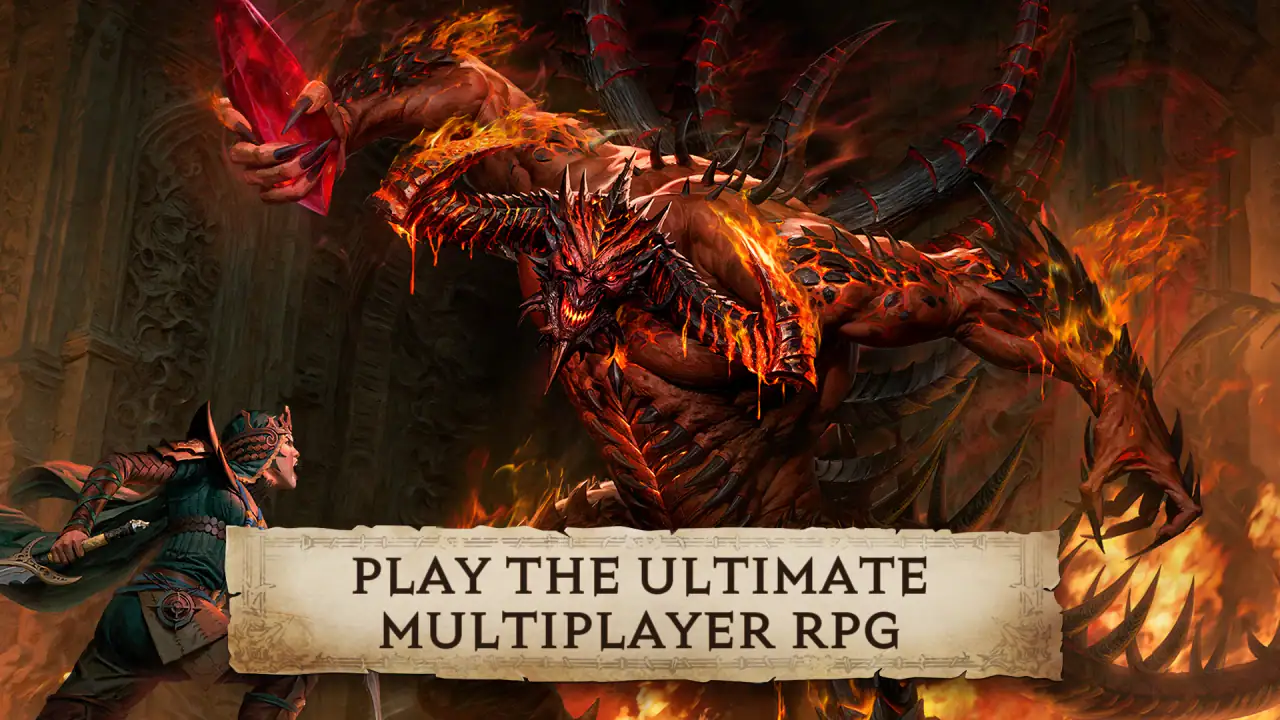
The setting works because it does not rely only on written explanations. The visual direction constantly reinforces the feeling of a world shaped by conflict between angels, demons, and desperate human survivors. I notice this in the contrast between battered settlements, threatening wilderness, and spaces that feel corrupted rather than merely dangerous. The art is not bright or playful, and that consistency gives the game a clear identity even when I am moving quickly through familiar combat situations.
What I like most is the way the environments make progression feel physical. A new area is not just another colored section on a map; it usually carries a different emotional weight through its architecture, lighting, enemy presence, and surrounding activity. The game communicates danger before I have studied every objective. That helps the world feel coherent, especially on a smaller screen where visual clarity matters more than tiny decorative details.
Related News

Why WhatsApp Messenger Still Makes Everyday Communication Feel Easy

Jurassic World: The Game Is the Better Dino Tycoon for Strategic Players

Threads in Real Life: Who Should Join, Lurk, or Leave

How SHEIN Turned Shopping Into an Endless Content Feed

How to Make Fortnite Feel Smarter on Mobile

Should You Switch to Microsoft Outlook on Mobile?
The presentation also supports the role-playing side without stopping the action too often. Characters, enemies, and locations are designed to suggest a larger history, but the game generally keeps me moving toward the next encounter. I do not need to read every piece of background material to understand the immediate stakes. At the same time, players who enjoy exploring the lore can spend more time with the setting and notice how its bleak tone is carried through locations rather than delivered only in exposition.
There is a useful trade-off here. The dark palette gives the game its personality, but it can make visual information harder to read on a small display, especially when several effects fill the screen. I found that I played more comfortably when I adjusted the display and used a screen large enough to separate enemies from environmental detail. This is not just a comfort issue: clearer visibility makes it easier to recognize threats, position my character, and avoid treating every fight as a blur of effects.
The world is also more convincing when I slow down slightly. Rushing from objective to objective can reduce the setting to a series of combat arenas, while taking a moment to look at the spaces reveals more of the intended mood. I would not call the exploration deeply free-form, but it does reward attention. The strongest parts of the presentation come from the combination of oppressive locations and the knowledge that the next battle is rarely far away.
Gallery
How the visual language affects everyday play
In practical use, the art direction helps me decide how to play a session. If I have only a few minutes, the clear combat-focused spaces make it easy to jump into an activity without needing a long preparation period. If I have more time, the same world gives me a reason to follow the story, inspect surroundings, and pursue progression beyond the immediate fight. That range is important for a mobile game, because my available attention changes constantly.
A realistic example is a commute or a lunch break. I can begin with a small objective, handle a cluster of enemies, and stop before the session becomes a major commitment. Later, I can return when I am at home and continue developing the character. The game feels best when I treat it as a series of connected sessions rather than expecting every play period to deliver a complete adventure.
Players who prefer cheerful fantasy, relaxed exploration, or a story that stays in the background should be cautious. The oppressive art and mature tone are not occasional decoration; they shape nearly every part of the experience. For me, that consistency is a strength. For someone looking for a colorful, low-pressure mobile RPG, it may become tiring rather than immersive.
Sound, combat rhythm, and the feeling of momentum
The sound design contributes to the game’s identity in the same way the environments do. Combat sounds have weight, and the overall audio direction supports the sense that attacks are colliding with something physical rather than simply triggering bright mobile effects. I found that the sound helped me stay engaged during repeated encounters, particularly when the screen became busy and I needed another cue to understand what was happening.
The music and ambient presentation are most effective when they give space to the darker locations. Instead of making every moment feel equally dramatic, the audio helps separate travel, preparation, story movement, and battle. That variation matters because the game contains a lot of fighting. If every moment used the same intensity, the experience would become exhausting much faster.
Its pacing depends on a loop that is easy to recognize: move, fight, collect, improve, and continue. The loop is satisfying when I can see a practical reason to take on the next encounter. A stronger piece of equipment, a more capable character, or access to a new challenge gives the session direction. The problem is that repetition becomes more obvious when I am playing without a clear personal goal. The atmosphere can carry the first sessions, but it cannot completely replace meaningful momentum.
My best approach is to set a narrow objective before starting. I might decide to advance the current story, improve a particular part of my build, or clear a specific activity rather than wandering through every available option. This simple habit reduces menu fatigue and makes the game’s rhythm feel deliberate. Without that focus, the number of possible directions can make a short mobile session feel less efficient than it should.
The game also benefits from alternating intensity. I would not recommend treating every session as a race through the hardest available content. Shorter battles and routine progression can be useful when I am tired, while more demanding encounters are better saved for a time when I can pay attention to positioning and ability timing. That distinction is easy to overlook because the game always presents another reason to keep going.
Where the mobile format helps and where it gets in the way
Touch controls make the action accessible, but they also create a gap between the idea of precise combat and the reality of playing on a phone. Movement and attacks are straightforward enough to learn, and the interface is built around quick decisions. Still, when many enemies, effects, and objectives appear together, my fingers can feel less exact than they would with a traditional controller or mouse and keyboard.
This is where the game differs from a conventional desktop action RPG. On a larger platform, I usually expect more deliberate control and a longer uninterrupted session. Here, the design is more forgiving of interruptions and shorter play periods, but the price is that some encounters feel less tactile. I prefer it when the challenge comes from choosing the right ability or position rather than fighting the touch interface.
It is also worth considering the phone itself. The game’s visual and combat ambitions are higher than those of a simple puzzle or idle RPG, so the experience is more demanding in attention and device comfort. I would use headphones when possible and avoid starting a serious session when I know I will be interrupted every minute. The game can accommodate casual play, but its strongest atmosphere appears when I give it enough uninterrupted time to build tension.
Progression, combat choices, and the cost of convenience
As a role-playing game, Diablo Immortal is at its most compelling when combat and character growth support each other. I am not just defeating enemies for its own sake; I am trying to make the next encounter more manageable, more efficient, or more interesting. Equipment and character development give ordinary battles a purpose, and the steady stream of improvements creates a satisfying sense of movement.
The important question is not whether progression exists, but whether I can manage it without losing sight of the game. There are enough systems and rewards to encourage regular play, yet that can also produce clutter. I sometimes found myself checking several parts of the interface before deciding what would actually improve my character. For a player who enjoys optimizing a build, this depth is appealing. For someone who wants to press start and fight, it can feel like administrative work between the exciting moments.
One useful habit is to compare upgrades by their effect on the way I actually play, not simply by treating every higher number as automatically better. If I rely on a particular attack pattern, an item or improvement that supports that pattern may be more valuable than a small general increase. This keeps the role-playing decisions connected to combat rather than turning progression into routine inventory sorting.
The free price makes it easy to test that loop before committing anything. I appreciate being able to discover whether the atmosphere, controls, and pacing suit me without paying at the start. However, optional purchases change how I think about long-term play. The listed purchase range extends from small amounts to items priced as high as $199.99, so I would recommend deciding on a personal spending limit before becoming invested in ongoing progression.
This is not an accusation that every player will have the same experience. Some people are comfortable ignoring purchases and simply enjoying the available game, while others may feel pressure when they see faster or more convenient paths. My advice is to judge the game by the strength of its free play first. If the core combat is not satisfying without spending, buying more will not solve the underlying problem. If the loop already feels good, optional purchases are easier to treat as a boundary I control rather than a requirement.
The game is a better fit for players who enjoy long-term character development, repeated combat, and the satisfaction of gradually refining a build. It is less suitable for someone who wants a self-contained story with a clear ending in a few evenings. Compared with a traditional premium action RPG, this mobile release offers more flexibility and ongoing reasons to return, but it also brings a more persistent progression structure and a stronger need to manage distractions.
Who should install it, and who should look elsewhere
I would recommend it to a Diablo fan who wants to play away from a console or computer, especially if that person enjoys checking in regularly rather than finishing everything in one uninterrupted campaign. It also suits mobile players who want combat with a darker tone and more character development than a typical casual game provides.
I would suggest a different type of game to anyone who dislikes repeated battles, complex progression screens, or optional purchases in a free-to-play environment. A premium single-player RPG may be a better choice when the priority is a fixed experience with fewer long-term systems. A traditional multiplayer RPG may also be preferable for players who want deeper social coordination and a larger-screen control setup.
The Mature 17+ classification is another practical consideration. The violence and demonic setting are central to the experience, not minor elements that appear only in a few scenes. I would not choose it for a child’s device or for someone who wants a gentle fantasy atmosphere. The rating should be treated as part of the game’s identity, not merely a label attached to the store page.
Device compatibility begins with Android 6.0, and the current version is 5.0.4. Those details make the entry requirements clear, but compatibility alone does not guarantee an equally comfortable experience on every phone. I would still check available storage, battery behavior, and screen comfort before planning long sessions. The game is much easier to appreciate when the phone can display its combat clearly and remain comfortable during extended play.
My final view on the atmosphere and the action
After spending time with it, I see Diablo Immortal as a game built around coherence. The art, sound, setting, and combat all point toward the same grim fantasy mood. Even when the progression becomes busy or a fight starts to feel familiar, the world rarely loses its identity. That matters because atmosphere is doing real work here: it gives repeated encounters context and makes the next area feel worth reaching.
The strongest experience comes from balancing the game’s available depth with a clear personal pace. I would not try to complete every activity, inspect every reward, and optimize every decision during a short break. Instead, I would choose one goal, play until I reach it, and stop before the menus and repetition take over. This turns the mobile format from a compromise into a genuine advantage.
There are fair reasons to hesitate. Touch controls cannot fully replace a larger setup, the dark presentation may become visually tiring, and the free-to-play structure requires self-control around optional purchases. The ongoing progression can also be too busy for players who prefer a clean, finite adventure. Those issues are not deal-breakers for me, but they should shape expectations before installation.
For my taste, the game succeeds because it makes portable play feel connected to a larger role-playing experience rather than reducing the setting to a decorative skin. The combat gives the atmosphere movement, the sound gives battles weight, and the progression gives me a reason to return. I would recommend Diablo Immortal to players who want a dark, combat-focused RPG they can revisit in short or long sessions, provided they are comfortable with its mature tone, repeated progression, and optional spending model.
My final recommendation is therefore positive but specific: install it if the combination of demonic fantasy, fast encounters, character improvement, and mobile convenience sounds appealing. Approach it as an ongoing game rather than a brief campaign, set boundaries around purchases, and keep each session focused on a practical goal. With those expectations, it delivers a surprisingly consistent mood and enough mechanical substance to justify returning beyond the first impression.
FAQs for Diablo Immortal
Is Diablo Immortal free to download and play?
Yes, Diablo Immortal is free to download on Android and iOS, and you can complete the main story, explore zones, join events, and develop several characters without paying. However, it includes optional in-app purchases, including currency, battle passes, cosmetic items, and progression-related bundles. Spending is not required for casual play, but competitive players may notice stronger advantages for users who invest money.
Does Diablo Immortal require an internet connection?
Diablo Immortal requires a reliable internet connection because it is designed as an online action RPG. Story areas, multiplayer activities, events, character progression, and account data are connected to Blizzard’s servers. It is therefore not a suitable choice for completely offline gaming. A stable Wi-Fi or mobile data connection is recommended, especially during dungeons, raids, and crowded public areas.
Can Diablo Immortal be played comfortably on older phones?
The game can run on many recent Android and iOS devices, but performance depends greatly on the phone’s processor, graphics hardware, available storage, and operating-system version. Older or entry-level devices may experience longer loading times, reduced visual quality, heat, or frame-rate drops. Before installing, check the current store requirements and make sure you have enough free space for the initial download and later updates.
Is Diablo Immortal suitable for players who are new to Diablo games?
Yes. Diablo Immortal introduces the setting, classes, combat, equipment, quests, and progression systems gradually, so newcomers can begin without knowing the previous games. The controls are adapted for touchscreens, with straightforward movement and skill buttons. Nevertheless, the title becomes more complex later through legendary gear, builds, factions, raids, and competitive modes, so new players may need time to understand its many systems.
Does Diablo Immortal support multiplayer and cross-platform play?
Diablo Immortal is built around online social play and lets you team up with other players for dungeons, raids, world events, bounties, and several competitive activities. Cross-platform functionality is available between supported mobile and PC versions, although features and requirements can change with updates. You will generally need a compatible account and server selection, and playing with friends may require coordinating the same region or server.
Pros
- Deep character customization with multiple classes
- skills
- and legendary gear.
- Frequent events and seasonal content provide new goals to pursue.
- Strong voice acting and cinematic presentation enhance the dark fantasy atmosphere.
- Cross-progression lets you continue playing across supported mobile and PC devices.
- Short activities make it easy to enjoy meaningful progress in brief sessions.
Cons
- Heavy reliance on online connectivity prevents offline play.
- Inventory management becomes tedious when collecting large amounts of loot.
- Some advanced features and rewards are locked behind lengthy progression.
- PvP balance can feel uneven between free players and heavy spenders.
- The game requires substantial storage space and may drain battery quickly.


